
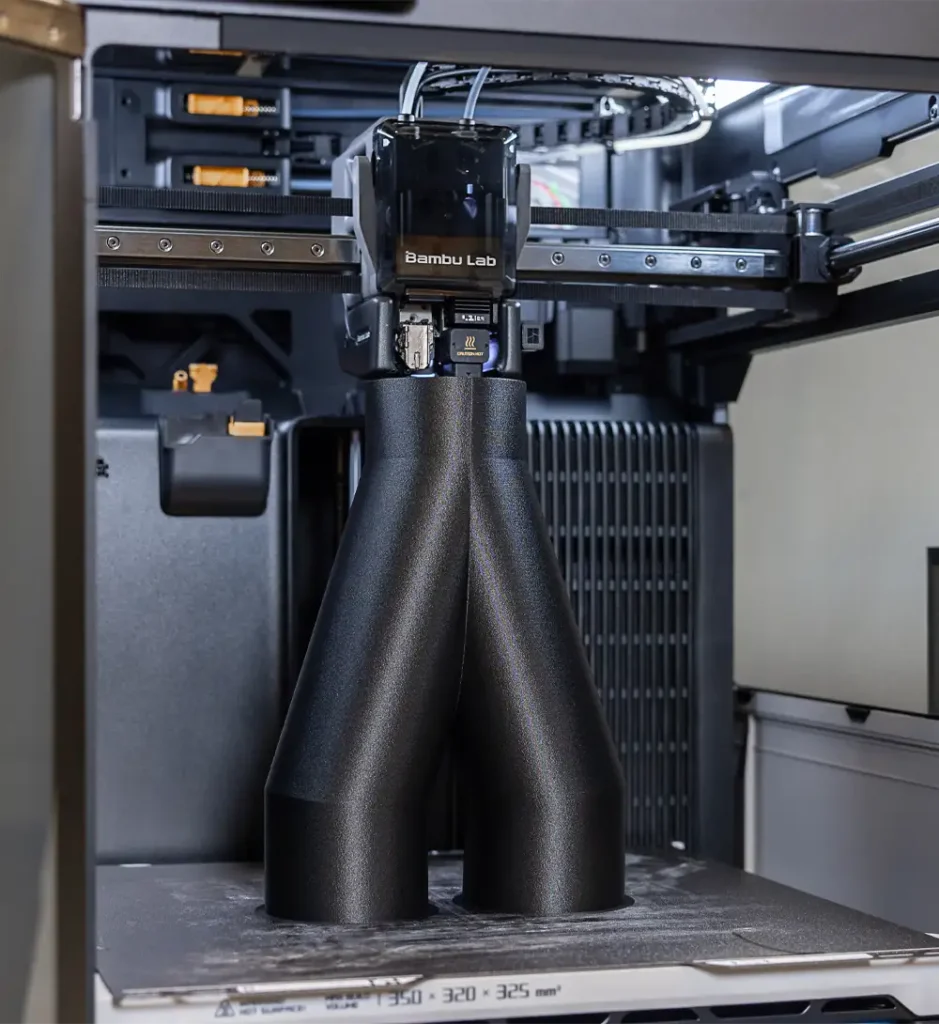
Choosing the right filament determines whether the 3D print will meet the requirements set for it. There are many differences between materials, which is why it is important to choose a material that is suitable for the intended use.
PLA filament
PLA is the most common and popular material in 3D printing due to its ease of printing and clean print quality. PLA is an easy-to-use material that is suitable for all types of 3D printers. PLA (polylactide) is a biodegradable plastic made from renewable natural resources such as corn, sugar cane, and starch. The material has good mechanical strength and low shrinkage, so it prints well even without a heated bed.
Read more ->
Applications for PLA filament
- Prototypes and product design
- Miniature models, decorative items, and toys
- Low-load operating equipment
- Products and parts intended for indoor use
The use of PLA is limited by its poor heat resistance and low impact strength. The material is therefore best suited for decorative items and prototypes intended for indoor use. Basic PLA is not suitable for outdoor use.
PETG filament
PETG is a mechanically durable, tough, and slightly flexible 3D printing filament. PETG is highly resistant to impact and chemicals and is suitable for outdoor use (resistant to moisture and UV light). PETG is made from glycol-modified polyester, which improves the material's impact resistance and interlayer adhesion. PETG is printed at moderate speeds and with careful temperature settings to avoid stringing and achieve a durable, clean finish. The material is not biodegradable, but it is fully recyclable.
Read more ->
Applications for PETG filament
- Functional and technical components
- Cases and protective covers
- Fasteners and adapters
- Products intended for outdoor use
- Parts exposed to moisture
- Mechanical components with light loads
- Products requiring food contact, such as beverage bottles (material requires FDA approval)
- Prototypes that require durability
PETG is ideal for parts that require strength and durability.
It is the right choice when PLA is no longer sufficient.
ABS filament
ABS is a very strong, rigid, impact- and heat-resistant 3D printing material. ABS is made from oil-based plastic. ABS filament is more demanding to 3D print than PLA or PETG, as it requires a high printing temperature and a closed 3D printer. ABS warps and shrinks easily when cooling.
Read more ->
Applications for ABS filament
- Functional parts and products designed for heavy-duty use and continuous loading
- Vehicle parts
- Machine parts
- Enclosures and structural components
- Industrial prototypes
- Heat-resistant components
ABS is suitable for products that require strength, mechanical durability, and heat resistance.
It is an excellent choice for industrial and technical applications.
TPU filament
TPU is an elastic, flexible, and impact-resistant filament. TPU bends, flexes, and returns to its original shape. TPU is made from thermoplastic polyurethane (combining the flexibility of rubber and the durability of plastic). Due to its flexibility, TPU is a demanding 3D printing material. It is printed at slow speeds, with low or no retract settings, and with carefully controlled feed rates to prevent the flexible filament from bending during printing.
Read more ->
Applications for TPU filament:
- Seals and covers
- Shock-absorbing parts
- Flexible fasteners
- Enclosures and protective covers
- Rubber-like technical parts
- Ergonomic gripping surfaces
TPU is ideal for parts that require flexibility and grip.
Nylon filament
Nylon is a very strong, tough, and wear-resistant 3D printing material. The most common grade is PA6.66 (a blend of PA6 and PA12), which is a polyamide-based nylon with excellent mechanical strength and heat resistance. Nylon filament is demanding to 3D print, as it requires high printing temperatures, dried material, and a closed 3D printer. Nylon easily absorbs moisture from the air, which directly affects the print quality and durability of the final result.
Read more ->
Applications for nylon filament:
- Technical parts requiring high strength
- Moving and wearing components
- Bearings and bushings
- Gears
- Mechanical fasteners
- Industrial machine parts
- Loaded structural components
- Prototypes that need to last a long time
Nylon is an extremely tough and wear-resistant material that offers industrial-grade performance for demanding mechanical parts and products.
A summary of the differences between the most common 3D printing materials
3D printing filaments differ from each other in terms of printability, durability, flexibility, and heat resistance. The right choice of material directly affects the functionality and service life of the final product.
PLAis the easiest 3D printing material.
It provides a clean surface but does not withstand heat and stress well.
PETGis a versatile general-purpose material.
It withstands moisture and mechanical stress better than PLA.
ABSis a technical and heat-resistant filament.
It requires a closed 3D printer, but offers strength and impact resistance.
TPUis a flexible, rubber-like material.
It is suitable for shock-absorbing and elastic parts, but is difficult to 3D print.
Nylonis the highest-performance filament.
It offers maximum strength and wear resistance, but is a demanding material to 3D print with.
Summary at a glance
Ease of use →PLA
General durability →PETG
Heat resistance →ABS
Flexibility →TPU
Maximum strength →Nylon
The Aliner3D online store offers a wide selection of high-quality Italian filaments from FiloAlfa – technical, bio-based, and recyclable options for 3D printing.
FiloAlfa specializes in demanding specialty filaments, and its selection offers a solution for every need. From basic PLA to carbon fiber-reinforced specialty filaments and everything in between, you'll find everything you need for 3D printing.
Filament offer: buy at least 6 filament rolls and get a 15% discount (the discount will be applied automatically at checkout).Free shipping on orders over €300. Go to shopping ->
Need help choosing the right filament quality?Contact us ->
We are happy to help with any questions or projects!
We provide all3D servicesunderoneroof, from design to manufacturing. From idea to finished product quickly and cost-effectively! Check out our 3D services here ->