
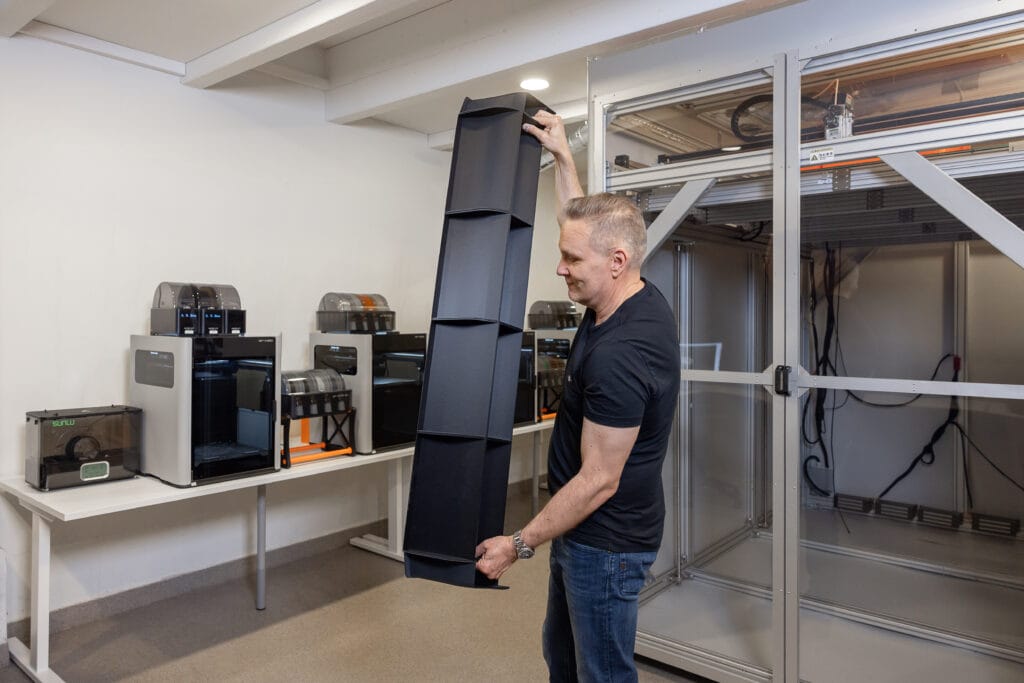
3D printing is a manufacturing method in which a three-dimensional object is created layer by layer from a digital 3D model.
What is 3D printing and how does it work?
3D printing is a manufacturing method in which a product is built layer by layer based on a digital 3D model. The method is also called additive manufacturing because no material is removed; instead, the product is created by adding material layer by layer according to the 3D model. There are several 3D printing techniques, each with its own purpose, materials, and advantages.
The most common 3D printing techniques:
FDM / FFF
It uses plastic filament as raw material, which is fed into the print head. The print head melts the filament and extrudes it in thin layers onto the print bed, building up the object layer by layer.
FGF
Uses plastic granules as raw material, which are fed into the print head. The print head melts the granules and extrudes the material in thin layers onto the print bed, building up the object layer by layer. This method is best suited for larger objects.
SLA / DLP
Uses liquid photopolymer resin as raw material. The resin is cured layer by layer using light, either from a laser (SLA) or a projector (DLP).
SLS
Uses powdered plastic, usually nylon, as raw material. The laser sintered the powder layer by layer into a solid piece in a powder bed without any support structures.
MJF
Uses powdered plastic as raw material. The print head sprays a binding agent onto the powder layer, which is melted into a solid piece using thermal energy. The method does not require any support structures, as the surrounding powder supports the piece during 3D printing.
Summary of 3D printing techniques:
FGF manufacturing technology is based on the same operating principle as FDM/FFF printing, but plastic granules are used as the raw material instead of plastic filament. SLA/DLP methods use liquid photopolymer resin, which is cured layer by layer using light. SLS and MJF methods use powdered raw materials, but their manufacturing techniques differ from each other.
What is required for 3D printing?
3D printing is based on a digital 3D model. The model serves as instructions for the 3D printer and determines the shape, dimensions, and structure of the object.
There are two ways to create a 3D model. The first option is to create a new 3D model based on an old part using 3D scanning and reverse engineering. The second option is to design the product using 3D software (CAD software) based on an idea or sketch.
3D printing of the finished 3D model
Once the 3D model is ready, it is exported to a printing program, which prepares it for printing. The program slices the model into thin layers, and the 3D printer builds the object layer by layer based on this information.
The printing process uses an additive manufacturing method, in which material is added only to the necessary areas. This avoids material waste and achieves excellent accuracy. If necessary, the 3D printer creates support structures that prevent the piece from warping and ensure successful 3D printing.
We provide all 3D services under one roof, from design to manufacturing!
Discover Aliner3D's 3D services:
3D scanning and reverse engineering
We are happy to help with any questions or projects you may have, so please don't hesitate to contact us!
Pekka Salo
sales@aliner.fi
+358 500 683 101
Almost anything can be 3D printed – spare parts, prototypes, scale models, and products for various purposes. Aliner3D can help when you need a product that is not readily available. We can manufacture it even without drawings.