
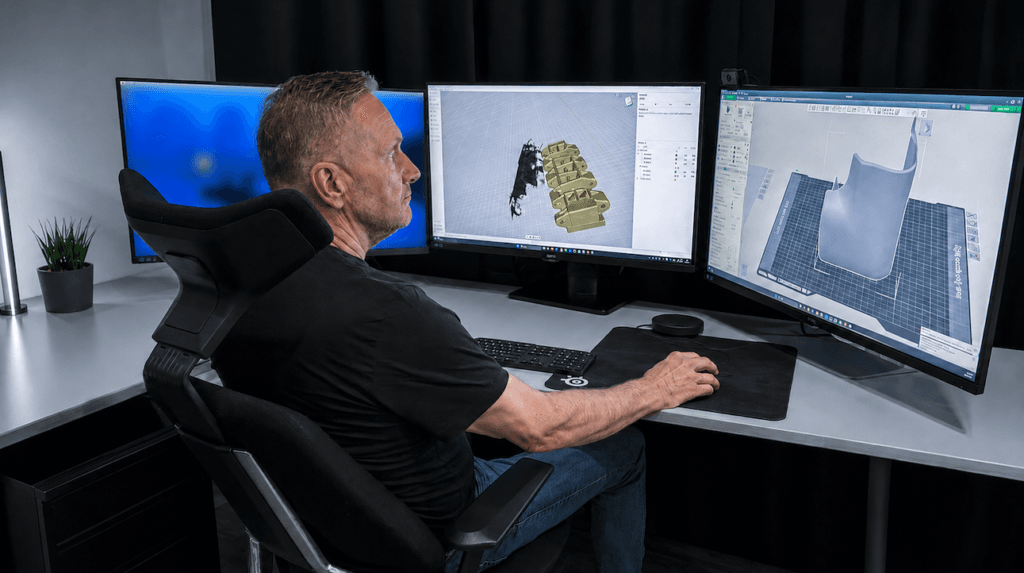
The primary purpose of a prototype is not to look perfect. Its purpose is to provide reliable information for product development. A 3D-printed prototype turns a design into a physical test piece. It allows the product’s size, fit, usability, and structure to be evaluated before final production.
What is a prototype?
A prototype is a test version of a product or part. It is manufactured before the final product so that the design can be evaluated in practice. A prototype can be a simple model, a precise fit model, or a functional test piece.
What can be tested with a prototype?
A solution that looks impressive on a computer screen doesn't always work the same way as a physical product. A prototype helps identify flaws at a stage when changes can still be made to the 3D model.
A prototype can be used to verify, for example:
- product size and proportions
- Compatibility of parts and required clearances
- the location of mounting points, holes, and openings
- system performance
- movements and mechanisms
- usability and ergonomics
- the product's appearance and shape
- potential weaknesses in the structure
It's a good idea to set a single, clear goal for the first prototype. This way, the test model won't become unnecessarily complex or expensive.
Three Common Types of Prototypes
A prototype demonstrates how the design works in a specific test. It does not, on its own, prove the product's long-term durability or suitability for all operating conditions.
Products subject to load and those critical to safety require a separate evaluation and the necessary tests. In the final design, in addition to the material, considerations must include dimensions, tolerances, the direction of manufacture, and the actual operating environment.
A prototype illustrating the appearance
A mockup is used to evaluate a product's shape, size, and proportions. It can also be used to present an idea to a client, a design team, or a decision-maker.
A prototype does not need to withstand the loads of the final product. Therefore, it can often be made from a material that is easy to print and cost-effective.
A prototype for testing the fit
A fit-up model is used to verify whether a product fits into the space allocated for it and whether it aligns properly with other components. At the same time, it allows for testing mounting points, holes, and clearances between components.
It is not always necessary to print the entire product. For testing purposes, only the joint, fastening, or other critical area needs to be produced.
Functional prototype
A functional prototype is used to test the product's usability, moving parts, or load-bearing capacity. In such cases, the material and structure must adequately reflect the property being tested.
However, a functional prototype is not automatically the final product. The print orientation, structure, material, and print settings all affect the part's properties.
Why is 3D printing suitable for prototyping?
In 3D printing, a physical object is produced based on a digital 3D model. No mold or product-specific manufacturing tool is required, so the method is well-suited for individual test pieces and varying versions.
Changes are made to the 3D model. After that, the new version can be manufactured without having to create an entirely new production tool.
This brings practical benefits to product development:
- An idea is quickly turned into a physical object
- Errors and areas for improvement can be identified before final production
- Different sizes, shapes, and structures can be compared
- Changes can be applied directly to the 3D model
- the product can be presented and evaluated in a concrete way
- Development decisions are based on an actual test specimen
In rapid prototyping, the digital design and the physical prototype are developed in turn. This iterative approach can be applied using various 3D printing methods and materials.
A prototype can reduce the risk of costly changes
A design flaw discovered late in the process may require changes to the manufacturing process, tools, or products that have already been manufactured. A prototype can help identify the problem before this stage.
The main benefit comes from testing critical aspects in the correct order. First, you can check the size and fit; then, the functionality; and finally, the finishing touches.
A prototype also makes decision-making easier. It is often easier to evaluate a physical object than a drawing or a 3D model on a screen.
The material for the prototype is selected based on the test
A prototype does not always have to be made from the same material as the final product. A less expensive material can be used for a piece intended to test the appearance or fit.
In a functional test, the material’s stiffness, flexibility, heat resistance, or wear resistance must support the test’s objective. The structure of the part and the print orientation must also be taken into account.
It is best to choose the material in consultation with the service provider. With Aliner3D’s 3D printing service, the material and settings for each part are selected based on the intended use.
Prototype Design and Manufacturing with Aliner3D
Aliner3D provides 3D design and 3D printing services for prototypes in Oulu. We can start the project based on an idea, a sketch, images, dimensions, an existing object, or a finished 3D model.
If a 3D model is not available, Aliner3D’s 3D design service can create a manufacturable 3D model that can be modified later. If necessary, an existing part can be converted into a 3D model using 3D scanning and reverse engineering.
Frequently Asked Questions About 3D-Printed Prototypes
Do you need a finished 3D model for the prototype?
3D printing always requires a 3D model. Aliner3D can design a 3D model for you based on an idea, a sketch, images, or measurements.
Does the prototype have to be made from the final material?
Not always. The material is chosen based on what the prototype is intended to test.
Is it possible to print only part of a prototype?
Yes. If the goal is to check a single joint, fastener, or detail, there is no need to manufacture the entire product.
Is the first prototype a finished product?
The purpose of the first version is to test the design. A simple product may work right away, but in many projects, the 3D model is modified based on the findings.
Test the idea before final production
Do you have a product idea, a sketch, or a finished 3D model? Send us your materials, the key dimensions, and the intended use, and we’ll evaluate the best approach for creating a prototype.
Request a quote for prototype manufacturing
We're here to help! Get in touch, and we'll do whatever you need.
Aliner3D
aliner3d@aliner.fi
Pekka Salo
+358 500 683 101